

Antenuptial and Postnuptial Contracts in South Africa
Protecting what’s yours — before and after “I do”
Marriage is a journey of the heart, but it also marks a significant legal crossroads. In South Africa, the moment you say “I do,” you are not just committing to a person; you are entering a legally binding financial partnership. How your assets, debts, and future wealth will be managed depends entirely on one crucial document — or the absence thereof: your matrimonial property regime.
Many couples spend months planning the perfect wedding but give little thought to the legal framework that will govern their married life. Some assume that love and trust are enough to navigate financial matters. Others believe they can always “sort it out later.” The reality, however, is far more complex. South African law provides mechanisms for couples to structure their financial affairs both before and after marriage, but the rules, timelines, and consequences are strict and often misunderstood.
This article aims to demystify Antenuptial Contracts (ANCs) and Postnuptial Contracts, explain how they work within the South African legal system, and illustrate through real-world scenarios why getting the timing and process right is absolutely critical.
Table of Contents
ToggleThe default position: In community of property
Before diving into contracts, it is essential to understand what happens if you do nothing. In South Africa, if you get married without an Antenuptial Contract, the law automatically assumes you are married in community of property. This is the default position for all marriages in the country, be it civil or customary.
Being married in community of property means that your separate identities, as far as assets and liabilities are concerned, cease to exist. You and your spouse become joint owners of a single, unified estate. Everything you owned before the marriage is merged into this joint estate. Everything you acquire during the marriage also falls into this joint estate. There are only a few narrow exceptions, such as inheritances or donations that are specifically excluded by the terms of a will or deed of gift.
The most significant implication of this regime is joint liability. Both spouses are equally responsible for all debts, regardless of who incurred them. If your spouse runs up a massive credit card bill or takes out a business loan that fails, you are personally liable for that debt. Creditors can come after the joint estate, including assets that originally belonged to you, to settle those obligations. In a divorce, the joint estate is simply split fifty-fifty, regardless of who contributed what.
For many couples, this level of financial entanglement is either undesirable or downright dangerous. This is where the Antenuptial Contract becomes invaluable.
The Antenuptial Contract (ANC): Planning before the wedding
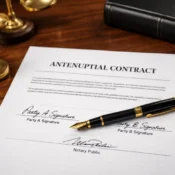
An Antenuptial Contract is a legal agreement signed before a couple marries. Its primary purpose is to exclude the community of property regime, allowing the parties to marry out of community of property. This agreement must be prepared by a notary public and signed in the presence of a notary and two competent witnesses. Crucially, it must be registered at the Deeds Office within three months of the date of signature to be valid against third parties, such as creditors.
When you marry out of community of property, each spouse retains their own separate estate. You each own your own assets, incur your own liabilities, and have no claim on the other’s property simply by virtue of being married. If your spouse is sued by creditors, those creditors cannot touch your personal assets. This separation provides a layer of protection that is particularly important if one spouse runs a business, has significant pre-existing wealth, or works in a high-risk profession.
However, marrying out of community of property does not automatically mean you forfeit any share in the wealth accumulated during the marriage. The ANC can be drafted with or without the inclusion of the accrual system.
Under the accrual system, each spouse starts the marriage with their own initial estate. These values are recorded in the contract. During the marriage, the estates remain separate. When the marriage ends, either through death or divorce, the growth (the accrual) of each estate during the marriage is calculated. The spouse whose estate grew less has a claim against the other for half the difference.
When life intervenes: The postnuptial route
Despite best intentions, things do not always go according to plan. A couple might intend to sign an ANC but, due to a rushed wedding, a family emergency, a remote location, or even an oversight by their attorney, the document is never properly signed and registered. Legally, that couple is married in community of property, regardless of what they discussed or intended.
South African law does provide a remedy for such situations, but it is not as simple as just signing a piece of paper after the wedding. The path you must take depends entirely on why you are seeking the postnuptial agreement. Are you fixing a mistake, or are you making a deliberate change to an existing marriage?
Scenario one: The “We meant to do it” couple (rectifying an omission)
Sipho & Nomvula
They live in Johannesburg but travelled to a rural area for their traditional wedding. Before the wedding, they consulted an attorney and agreed on the terms of an ANC to marry out of community of property with the exclusion of the accrual system. They wanted to keep their families’ farming properties separate. However, in the flurry of travel and celebrations, the final signing with the notary was forgotten. They only realised their mistake a year later when they decided to buy a house together and their conveyancer asked for their ANC number.
This couple is not seeking to change their minds; they are seeking to formalise an agreement they had already made before the marriage. In legal terms, they need the court to authorise the postnuptial execution and registration of their antenuptial contract.
To succeed, they must approach the High Court and prove two things convincingly:
- That before their marriage, they had a valid meeting of the minds (consensus) regarding their intention to marry out of community of property.
- That there is a good and acceptable reason why the contract was not signed and registered timeously.
If the court is satisfied, it will grant an order allowing the contract to be signed and registered as if it had been done before the wedding. However, there is a critical caveat: this late registration does not protect the couple from any creditors that existed before the contract is finally registered. Any debts incurred during that year of unintended community of property remain joint liabilities.
This remedy is a safety net for those who genuinely intended to plan but failed due to circumstances. Courts have shown a willingness to grant these orders, recognising that a rigid application of the law could cause significant injustice to couples who made an honest mistake.
Scenario two: The “We changed our minds” couple (altering the regime)
Farida & Ahmed
They have been married in community of property for fifteen years. They have built a comfortable life, a family home, and some investments. Ahmed has now decided to leave his corporate job and start his own construction company. The business is risky, and he will likely need to take out loans and sign suretyships. Both Farida and Ahmed are deeply worried that if the business fails, creditors could come after their family home and all their joint assets. They want to change their marriage to out of community of property to protect what they have built together.
This situation is fundamentally different from the first scenario. This is not about correcting a past oversight; it is about making a deliberate, voluntary change to an existing legal regime that has governed their marriage for years. This process is governed by Section 21 of the Matrimonial Property Act.
Changing a marriage regime after the wedding is a serious matter that affects not only the spouses but also their creditors. The law therefore imposes a much stricter process. The couple must make a joint application to the High Court. The application must include:
- Full disclosure of all their assets and liabilities.
- The reasons for the proposed change.
- Proof that notice has been given to all their known creditors, giving those creditors an opportunity to object if they believe they will be prejudiced.
The court will only grant the order if it is satisfied that there are sound reasons for the change and that no creditor will be unfairly prejudiced by it. This is not a rubber-stamp process. It requires legal expertise, thorough preparation, and a willingness to open your financial affairs to court scrutiny.
The danger of informal agreements: Why “DIY” postnuptial contracts fail
A persistent and dangerous myth in South Africa is that a husband and wife can simply draft a private agreement, sign it in front of witnesses, and thereby change their matrimonial property regime. This is absolutely false. A private contract between spouses cannot override the legal status of their marriage, which is a matter of public record and affects the rights of third parties.
The courts have repeatedly and firmly rejected this notion.
Mans v Mans (Constitutional Court): The court examined the validity of a postnuptial agreement signed without court oversight. It held that you cannot simply override a registered Antenuptial Contract or the default community of property regime with a private contract. To do so would create chaos and uncertainty, particularly for creditors who rely on the public register.
SS v FK: A couple realised after their wedding that they had forgotten to sign an ANC. Instead of approaching the court, they drafted and signed their own postnuptial agreement, declaring that they were now married out of community of property. Years later, when they divorced, the court declared the agreement “void and of no force and effect.” They remained married in community of property, and the joint estate was divided accordingly.
These cases serve as a stark warning. A postnuptial agreement drafted at home is not worth the paper it is written on. It creates a false sense of security and can lead to devastating consequences when the marriage ends or when creditors come calling.
A special warning for couples in customary marriages
Recent legal developments have highlighted a significant trap for couples who enter into both customary and civil marriages. South Africa recognises customary marriages as valid and fully legal. If you enter into a customary marriage first, that marriage is automatically in community of property unless an Antenuptial Contract was signed before the customary marriage took place.
A common practice has been for couples to have a customary marriage first and then, months or years later, have a civil marriage. At the time of the civil marriage, they might sign an ANC, believing they are now married out of community of property. However, following a landmark Constitutional Court judgment in 2025, such an ANC is invalid.
Why? Because at the time of the civil marriage, the couple was already married under customary law. Therefore, the ANC signed for the civil marriage is, in legal terms, a postnuptial contract. To be valid, the couple would have needed to first obtain a court order under Section 21 of the Matrimonial Property Act to change their existing customary marriage regime. Without that court order, the ANC is void, and they remain married in community of property.
Expert insight: Bertus Preller
As family law expert Bertus Preller has noted, this ruling has far-reaching implications. Many couples who have believed for years that they were protected by an ANC are now discovering that they are, in fact, in community of property. This affects everything from divorce settlements to their vulnerability to creditors. It is a sobering reminder that legal formalities cannot be bypassed, even with the best intentions.
Key takeaways
- Plan ahead: If you want to be out of community of property, sign your ANC well before the wedding — with a notary, witnesses, and register it at the Deeds Office within three months.
- Don’t delay: If you failed to sign an ANC, you cannot fix it with a private document. You must approach the High Court — either to rectify an omission (prove prior consensus) or to apply under Section 21 if you genuinely want to change your regime.
- Customary marriages are marriages: If you are married customarily first, any subsequent ANC is a postnuptial contract and requires a court order to be valid.
- Get specialist advice: A postnuptial agreement is a powerful tool, but if done incorrectly, it is worthless. Always consult a notary public or family law attorney who specialises in matrimonial law.
Navigating the legal landscape of marriage in South Africa requires more than love and good intentions. It requires knowledge, foresight, and respect for the law.
An Antenuptial Contract is one of the most powerful tools a couple can use to protect their individual financial interests and define how their marriage will operate. It provides clarity, security, and peace of mind. The key is to plan ahead. Signing an ANC well before the wedding, with proper notarial execution and Deeds Office registration, is the simplest and most effective way to ensure your wishes are honoured.
If you find yourself married without the protection you intended, do not despair, but do not attempt a DIY solution either. The law provides pathways, but they lead through the courts. Whether you are rectifying an honest omission or seeking to change your regime for valid reasons, you must engage a specialist family law attorney or a notary public who can guide you through the correct legal process.
A postnuptial agreement is a valuable instrument, but only if it is done right. An informal agreement is worse than no agreement at all, as it lulls you into a false sense of security while leaving you legally exposed. In matters of marriage and money, the cost of proper legal advice is a small price to pay for the protection of your future.

Recent Posts

root0 Comments
Rescission of Judgment in South African

root0 Comments
What is a Default judgment ?
root0 Comments